The short answer: Yes — at the source. Kuwait’s desalinated water is treated to high international standards before it leaves the plant. The honest answer: what reaches your glass depends on everything in between — decades-old distribution pipes, your building’s plumbing, and the rooftop tank it sat in on a 50°C afternoon. That journey is called the last mile, and it’s where water quality is won or lost.
How is Kuwait’s tap water produced?
Nearly all of Kuwait’s potable water begins as seawater, processed through large-scale desalination plants and blended with a small portion of brackish groundwater for mineral balance. At the point of production, this water is disinfected, tested, and regulated. By global standards, Kuwait’s treatment infrastructure is genuinely advanced.
So if the question is “does the government deliver clean water?” — the evidence says yes.
But that’s not the question that matters for your family.
If the water is treated, why does quality vary from home to home?
Because treated water doesn’t teleport to your tap. It travels:
- Through the municipal network — kilometers of distribution pipes, some installed decades ago.
- Into your building’s plumbing — where aging galvanized pipes can contribute rust, sediment, and metallic residues.
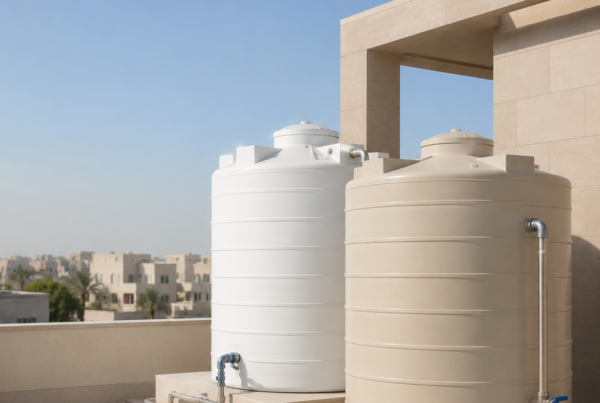
- Into a rooftop or ground storage tank — often exposed to extreme heat, and only as clean as its last maintenance visit.
- Through your internal lines — the final meters before your faucet.
Every one of those steps is outside the treatment plant’s control. Two identical apartments in the same district can pour visibly different water for one reason: different pipes, different tanks, different maintenance.
This is why the more useful question isn’t “is Kuwait’s water safe?” but “what happened to my water after it was treated?”
What can actually enter water along the last mile?
Independent water research consistently identifies the same recontamination pathways in aging distribution systems:
- Rust and iron oxides from corroding galvanized pipes — the source of yellowish or metallic-tasting water.
- Sediment and scale particles that accumulate inside lines and tanks over years.
- Chlorine byproducts — chlorine is essential for disinfection during transport, but many families prefer to remove its taste, odor, and residuals at the point of use.
- Biofilm and microorganisms that can develop in warm, stagnant storage tanks.
None of this means your water is dangerous. It means “treated at the plant” and “pristine at your tap” are two different claims — and only one of them can be verified in your own kitchen.
How can you check your own tap water?
Three practical steps, in order of effort:
- Look and taste. Discoloration after travel or a long weekend away, metallic notes, or visible particles when filling a white basin are all last-mile signals.
- Measure TDS. A simple TDS meter reads total dissolved solids in seconds. (Our guide Understanding TDS: What the Numbers Mean explains how to interpret the reading.)
- Book a professional water test. A proper in-home assessment measures what a pocket meter can’t — and tells you whether your building’s last mile needs attention at all.
What’s the most reliable way to protect water at the tap?
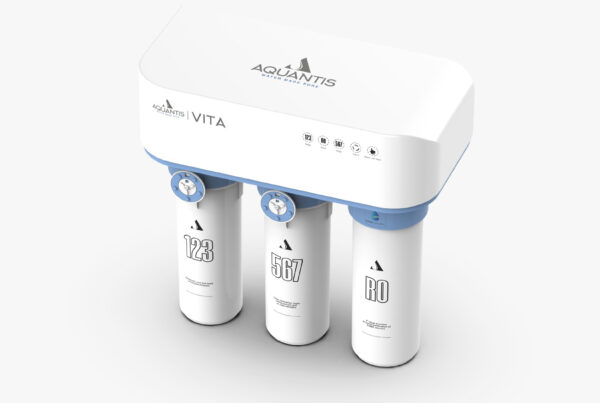
Point-of-use purification — treating water at the exact moment it reaches your family, after the pipes and tanks have done whatever they’ve done. A multi-stage system with a reverse osmosis membrane removes up to 99% of dissolved solids, heavy metals, and microplastics, while a mineralized output option restores balanced taste. This is precisely the gap the Aquantis range was engineered for: not to replace Kuwait’s treatment infrastructure, but to guard its final meters.
FAQ
Is it safe to cook with Kuwait tap water?
Generally yes, though the same last-mile variables apply. Cooking doesn’t remove dissolved metals or sediment — purified water is the more consistent choice for food and coffee.
Is bottled water safer than tap water in Kuwait?
Not automatically. Bottled water introduces its own variables — plastic storage, heat exposure during transport, and significant recurring cost. Point-of-use purification offers verified quality without the plastic.
Does boiling tap water make it pure?
Boiling neutralizes microorganisms but concentrates dissolved solids and metals rather than removing them.
How do I know if my building’s pipes are affecting my water?
Age is the biggest predictor. Buildings over 15–20 years old with original plumbing are the most likely to show rust and sediment effects. A free water test settles it definitively.
Visit supernaturalco.com to book your free water test today and see exactly what your last mile looks like.