The short answer: Almost every home in Kuwait stores its water in a rooftop or ground tank before it reaches the tap — and that tank is only as clean as its last professional service. In Kuwait’s climate, water authorities and maintenance professionals generally recommend cleaning storage tanks at least once a year, and every six months for older or heavily used tanks.
Why does Kuwait rely on water storage tanks?
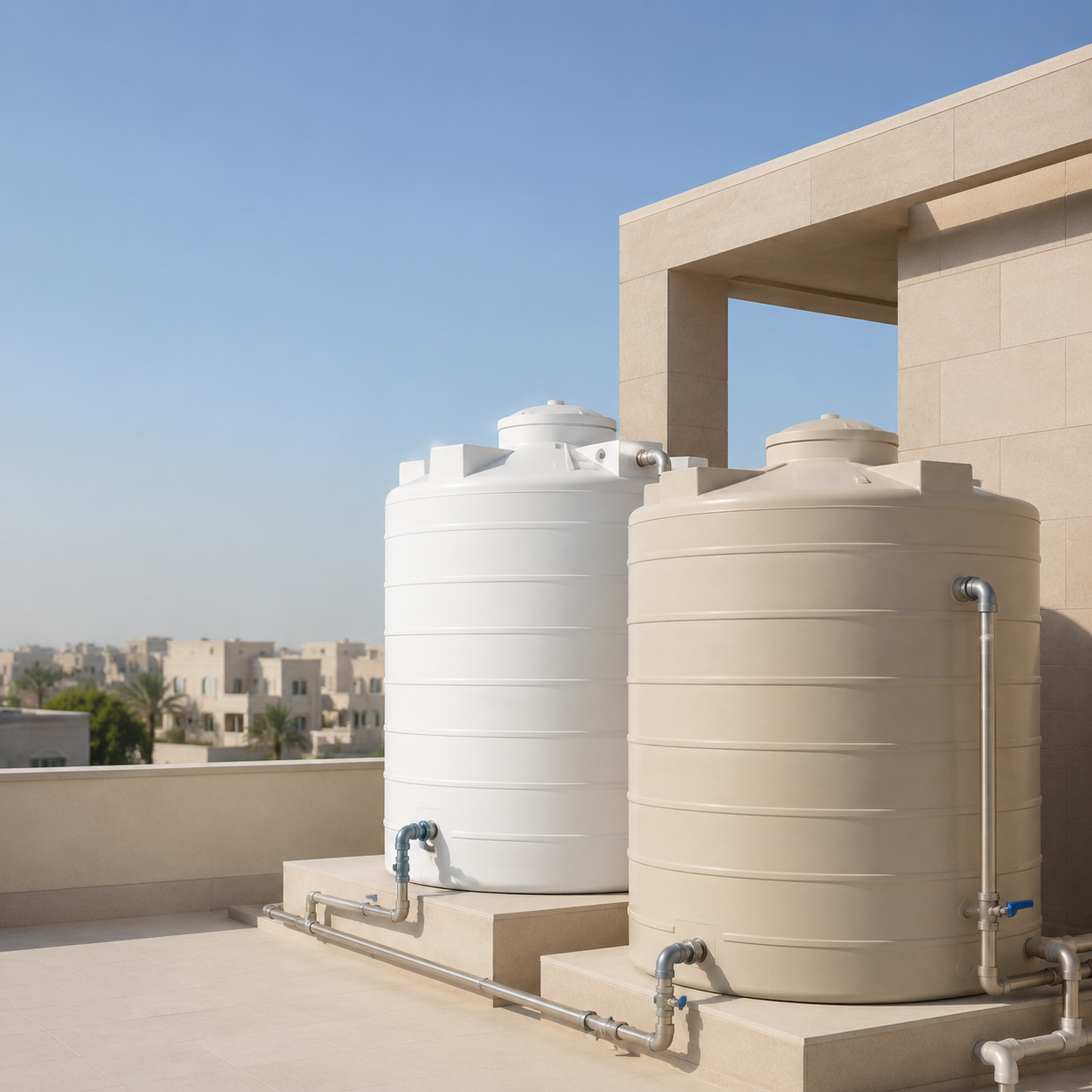
Kuwait’s distribution network delivers water to buildings, where it’s stored — usually in rooftop tanks, ground tanks, or both — to guarantee steady pressure and supply throughout the day. It’s a sensible system for a desert country. But it introduces a stage of the water journey that no treatment plant controls: hours or days of storage, on a roof, in one of the hottest inhabited climates on Earth.
Your water was treated to a high standard when it left the plant. The tank is where that guarantee quietly expires.
What actually accumulates inside a rooftop tank?
Professional tank-cleaning services in the Gulf report the same findings again and again:
- Sediment layers — sand, dust, and pipe particles settle at the bottom over months, especially after network maintenance or dust storms.
- Rust flakes — from the building’s own galvanized risers, collecting in the tank like a filter in reverse.
- Biofilm — a thin microbial layer that develops on interior walls, accelerated by warmth. Summer rooftop temperatures can push tank water well above the range where microbial growth accelerates.
- Degraded seals and fittings — aging gaskets and poorly sealed lids can admit dust, insects, and in neglected cases, birds.
- Chlorine decay — the residual chlorine that protects water in transit dissipates faster in heat, reducing protection precisely during the longest storage.
None of this is alarmist — it’s simply what storage does over time. The question is how you manage it.
How often should you clean your water tank in Kuwait?
A practical schedule:
| Situation | Recommended frequency |
|---|---|
| Standard residential tank, good condition | Once per year |
| Building over 15 years old / original plumbing | Every 6 months |
| After any network works or visible discoloration | Immediately |
| Commercial / hospitality use | Every 6 months minimum |
What a proper service includes: full drainage, mechanical scrubbing of walls and floor, disinfection, rinse, inspection of the lid, float valve, and seals — and ideally a before/after water clarity comparison.
Is tank cleaning enough on its own?
It’s necessary — but it addresses only one stage of the last mile. Even a freshly cleaned tank receives water through the same aging distribution and building pipes, and begins accumulating sediment again from day one. Cleaning resets the tank; it doesn’t change what flows into it or out of it.
That’s why the most robust household setup pairs two habits:
- Scheduled tank maintenance — an annual (or semi-annual) professional cleaning.
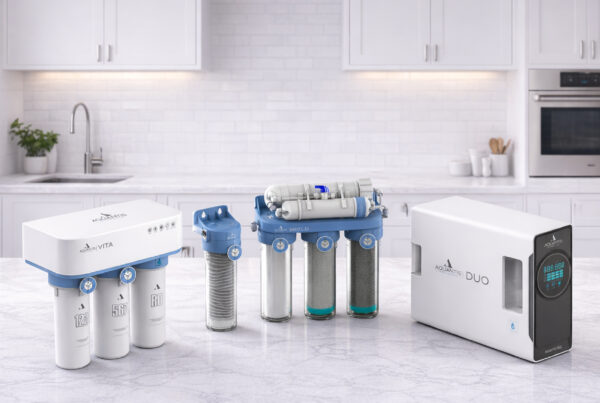
- Point-of-use purification — a multi-stage system at the tap itself, so that whatever happens upstream — in the network, the risers, or the tank — is resolved at the exact point water meets your family. This is the role the Aquantis range was engineered for: the final guardian after every storage and transport stage has done its work.
How can you tell your tank needs attention now?
- Water runs discolored for a few seconds when first opened, especially in the morning
- A metallic or earthy taste that wasn’t there before
- Fine particles settling in a white cup left to stand
- Reduced pressure from sediment-clogged lines
- It’s been over a year since anyone looked inside
Any one of these is a reasonable trigger to book both a tank service and a water test.
FAQ
How much does water tank cleaning cost in Kuwait?
Prices vary by tank size and access, but an annual professional cleaning is a small fraction of what most families spend on bottled water in a single month.
Can I clean the tank myself?
Draining and rinsing is possible, but proper disinfection and safe confined-space work are best left to professionals.
Does a rooftop tank make tap water unsafe?
Not inherently — a well-maintained tank performs fine. The risk comes from neglect combined with heat, which is why scheduling matters more than worrying.
Does point-of-use purification remove what tanks add?
A multi-stage RO system removes sediment, rust particles, dissolved metals, and up to 99% of dissolved solids — and in Aquantis DUO, a UV chamber neutralizes microorganisms as the final stage.
Not sure what your tank is adding to your water? Book a free in-home water test. → supernaturalco.com