Tankless vs. Tank RO Systems: Why the Difference Matters More Than You Think
The short answer: Both use the same core science — a reverse osmosis membrane. The difference is what happens after purification. Tank systems store purified water in a pressurized vessel for hours; tankless systems purify on demand, the moment you open the tap. That single design choice affects freshness, hygiene, space, and long-term maintenance.
What is a tankless RO system?
A tankless (or “direct-flow”) reverse osmosis system purifies water in real time. When you open the faucet, water passes through every purification stage — sediment and carbon pre-treatment, the RO membrane, post-treatment — and pours into your glass seconds later. Nothing is stored.
Traditional RO systems work differently: because older membranes produced water slowly, they needed a pressurized storage tank (typically 8–12 liters) under the sink, filling gradually and holding water until needed.
Tankless systems became possible when high-flow membranes — like the DuPont TAPTEC membrane at the core of Aquantis DUO — could produce purified water fast enough to skip storage entirely.
Why does storage matter for water quality?
Three reasons:
1. Freshness. Water in a tank may have been purified hours — or overnight — before you drink it. Direct-flow water was purified seconds ago. For taste and dissolved-oxygen freshness, the difference is noticeable.
2. Stagnation and hygiene. Any storage vessel is a potential environment for biofilm over time, particularly in warm climates. Tank interiors and their rubber bladders can’t be easily inspected or cleaned. A tankless design removes the question entirely: there’s no standing water to worry about.
3. Secondary contamination. Ironically, a traditional tank can re-introduce the very problem RO solved — water sitting in contact with tank materials after purification. Direct flow means the last thing your water touches is the final purification stage.
What are the practical advantages of going tankless?
- Space. No 10-liter tank means the under-sink cabinet stays usable — a genuine consideration in apartments and design-led kitchens.
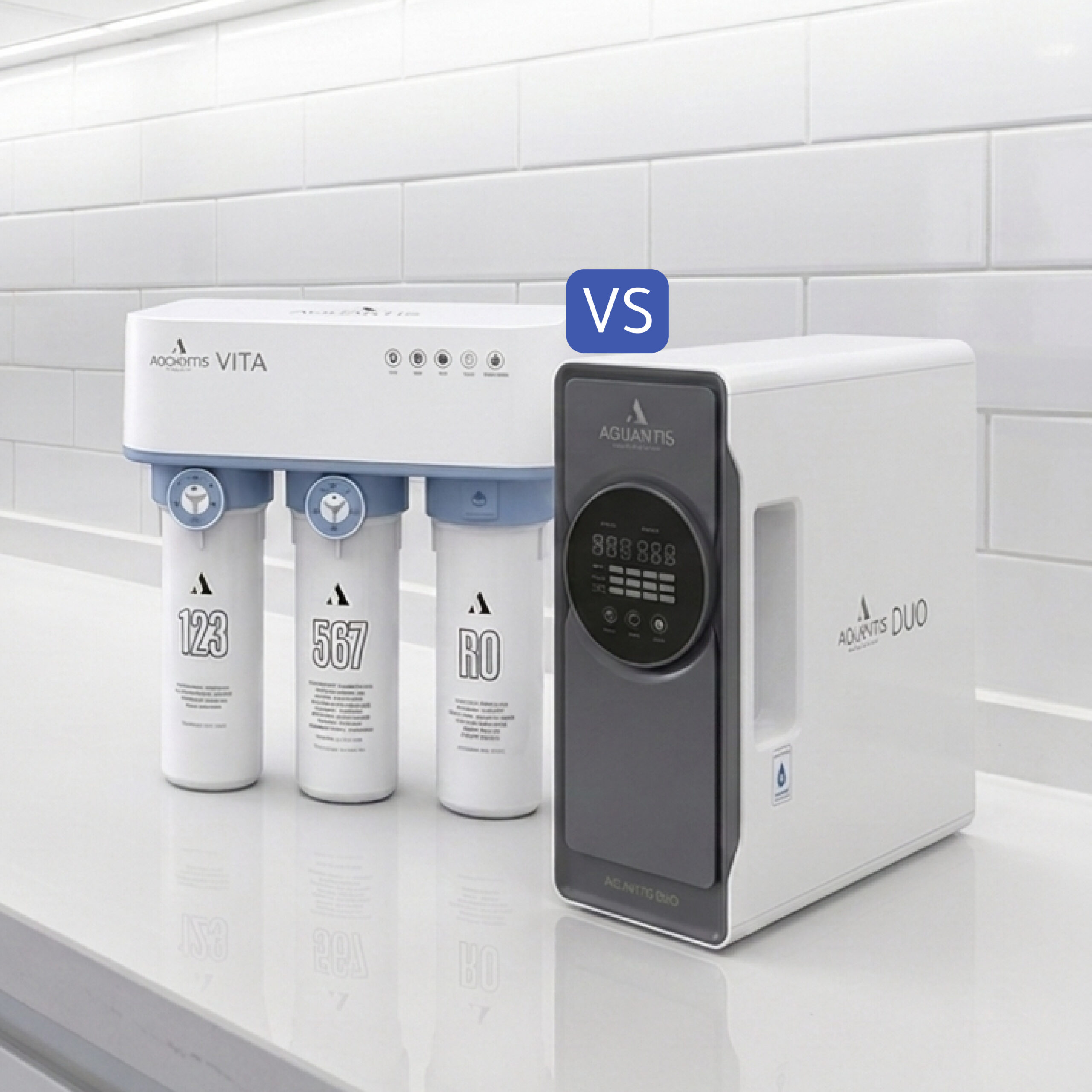
- Unlimited continuous supply. Tank systems run empty after a few liters and need time to refill. Direct-flow systems keep producing as long as the tap is open — filling pots, carafes, and coffee machines without waiting. Aquantis DUO and VITA are offered from 600 up to 1200 GPD — 94 to 189 litres per hour depending on configuration.
- Less water waste. Modern direct-flow membranes typically operate at better recovery ratios than older tank-based designs.
- Simpler maintenance. No tank to sanitize, no bladder pressure to check.
Is there any case where a tank system still makes sense?
Honestly: fewer every year. Tank systems can cost less upfront, and in homes with very unstable water pressure a tank provides a buffer. But for most Kuwaiti homes, the trade — stored water, lost cabinet space, tank sanitation — no longer justifies the saving, especially with installment plans starting at 13 KD/month bringing tankless technology into ordinary budgets.
What should you look for in a tankless system?
- Membrane pedigree — the membrane is the system. Ask who manufactures it. (DUO uses a DuPont membrane; DuPont is among the inventors of RO membrane technology.)
- Complete staging — pre-treatment protects the membrane; post-treatment polishes taste. Aquantis DUO runs the full 8-stage journey, including UV sterilization as the final guardian.
- Dual output — the ability to choose near-zero-TDS pure water or balanced mineralized water from the same device. Aquantis was the first system in Kuwait to offer both.
- Local installation and support — a tankless system is precision equipment; it deserves professional installation and ongoing local service.
FAQ
Is tankless RO better than tank RO?
For freshness, hygiene, space, and continuous supply — yes. Tank systems’ only remaining advantages are lower entry price and pressure buffering.
Does a tankless RO system waste water?
All RO produces some reject water, but modern direct-flow membranes generally achieve better recovery ratios than legacy tank designs.
How fast is a tankless system?
Direct-flow systems dispense purified water immediately at the tap — no waiting for a tank to refill.
Was Aquantis really the first tankless system in Kuwait?
Aquantis introduced the first tankless water treatment system in Kuwait offering both pure and mineralized water from one device.
See the tankless difference in your own kitchen — book a free consultation. → supernaturalco.com