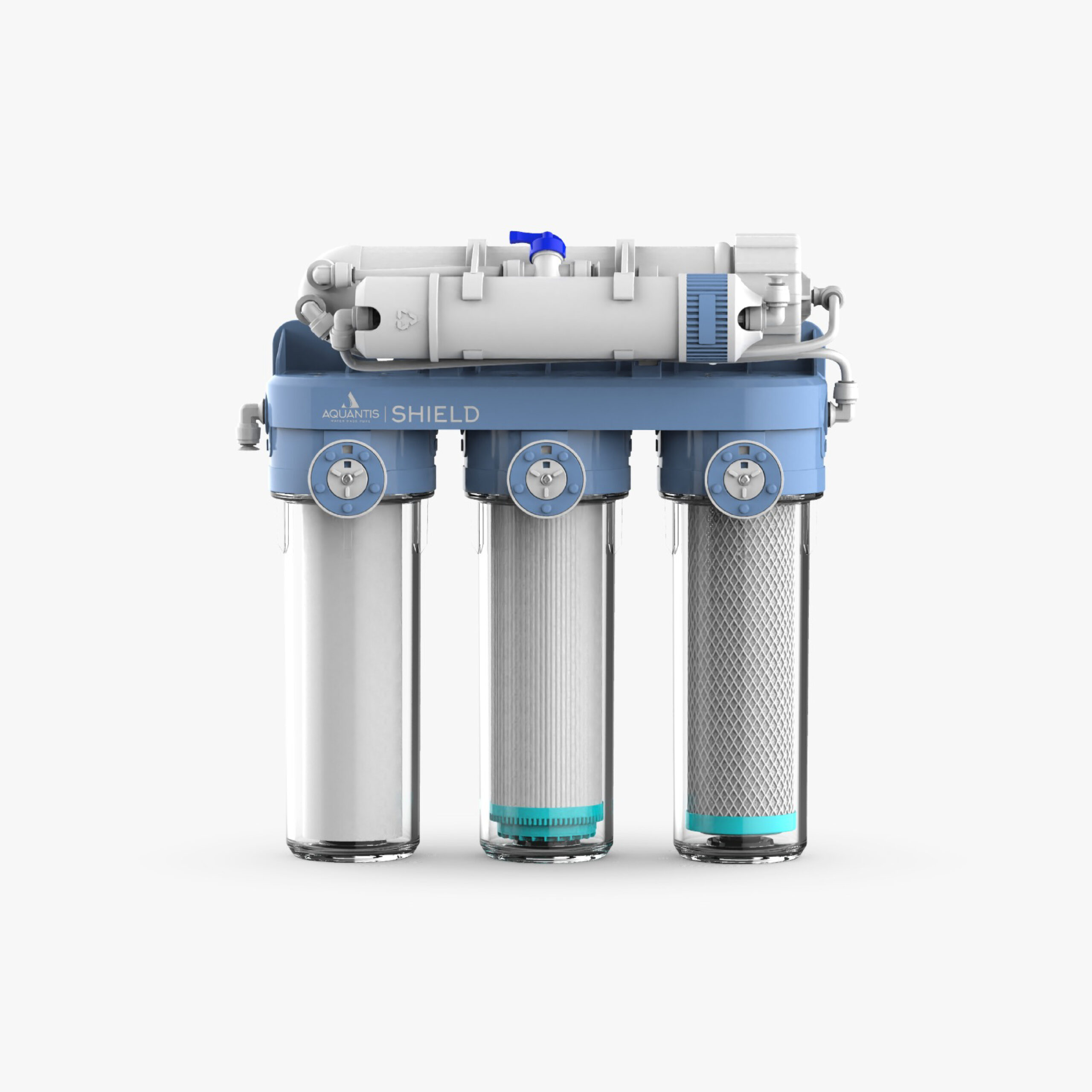
There is a quiet elegance to equipment that needs no power source. No socket under the sink. No pump cycling on at midnight. No electrical components counting down to their replacement date. SHIELD sits in the cabinet and works because water is already moving through it.
That simplicity is a design decision, not a limitation — and understanding what it makes possible is the point of this piece.
What SHIELD is built to do
SHIELD is a five-stage ultrafiltration system for municipal tap water. It intercepts what the last mile adds — sediment, iron rust, chlorine, disinfection byproducts, bacteria — while deliberately leaving your water’s dissolved minerals intact.
That last part is the design philosophy in a sentence. Calcium and magnesium are not contaminants. They contribute to taste and to daily dietary intake, and SHIELD’s membrane is engineered at a precision that lets them pass while stopping what shouldn’t.
The five stages, and what each one actually does
Stage 1 — PP cotton element. A 1-micron high-density fibre structure that intercepts visible impurities: sediment, iron rust, colloids and suspended solids. This is the workhorse stage, and the one that faces Kuwait’s dust and pipe particles first.
Replacement: within 3 months.
Stage 2 — Granular activated carbon. Adsorbs residual chlorine and disinfection byproducts such as chloroform, removes some heavy metals including lead and mercury, and clears abnormal colours and odours — the musty notes and sulfides that make water taste like plumbing.
Replacement: within 3 months.
Stage 3 — Sintered activated carbon. A second, denser carbon stage that goes deeper on chlorine, volatile organic compounds and pesticide residues. Its dense structure also captures colloids of 1 micron and above, micro rust and fine suspended solids — which protects the precision membrane sitting behind it from particle erosion and chemical corrosion.
Replacement: within 3 months.
Stage 4 — Hollow ultrafiltration membrane. The heart of the system. At 0.01-micron filtration precision, it intercepts suspended solids, bacteria and colloids by physical sieving — no chemicals, no electricity, just a pore size small enough to matter. And it retains the beneficial minerals, calcium and magnesium among them, that the body actually uses.
Replacement: within 12 months.
Stage 5 — Post-activated carbon. The final polish. Deeply adsorbs any residual odorous volatile organic compounds, improving clarity and taste in the last moment before water reaches your glass.
Replacement: within 12 months.
The catalogue adds a note worth repeating: cartridge lifespan varies with your water quality and how much you use. These intervals are a schedule, not a guarantee — check regularly, and replace when your water tells you to rather than when the calendar does.
What SHIELD needs from your home
Three conditions, all easy to verify before installation:
- Water source: municipal tap water
- Temperature range: 5–38°C
- Inlet pressure: 1–4 bar (14.5–58 psi / 0.1–0.4 MPa)
If your building’s pressure runs above that range, the catalogue recommends installing a pressure-reducing valve. This is worth checking rather than assuming — pressure varies considerably between older low-rise buildings and newer towers, and it is the single most common installation variable in Kuwait.
What isn’t on that list is a voltage requirement. There isn’t one.
Why “no electricity” matters more than it sounds
It’s easy to read no power needed as a minor convenience. In practice it changes three things:
Fewer failure modes. Pumps, control boards, solenoid valves and power adapters all have service lives. A system without them has fewer components that can age out between you and your water.
Nothing to install but plumbing. No socket to find, no cable to route, no electrician. The catalogue’s own installation sequence is mechanical throughout — mount the bracket, fit the inlet tee and faucet, seat each cartridge in its housing, lock the safety latch.
It keeps working when the power doesn’t. A meaningful consideration in any home, and a practical one during maintenance or outages.
Installation, briefly
SHIELD ships with everything the install requires: water inlet tee, dedicated purifier faucet, faucet mounting bracket, five metres of pipe, mounting screws, pipe cutter, tube pulling pliers, and both filter-housing and membrane-housing wrenches.
The sequence is straightforward — remove each cartridge’s protective film, seat the PP cotton element in the first housing, the GAC in the second, the CTO in the third, confirm full engagement of each housing alignment tab, tighten with the wrench, then lock the safety latch by inserting it vertically into the positioning groove. That last step matters: the latch is what prevents water-hammer-induced backlash leaks.
We handle all of this as part of installation. It’s described here because a system you understand is a system you’ll maintain.
If your first glass looks white
Almost every new owner asks about this, so here is the answer in advance: milky or white water from a newly installed system is almost always dissolved air, not a contaminant.
Under the pressure of the municipal network, dissolved gases — oxygen, nitrogen — come out of solution and form microbubbles roughly 10 to 50 microns across. They scatter light, which reads to the eye as cloudiness. The sintered carbon stage contributes slightly too: adsorption releases a small amount of heat, raising local temperature by about half a degree to a degree, which accelerates gas release.
The 30-minute test:
- Fill a transparent glass with the purified water.
- Leave it undisturbed in a dark place for 30 minutes.
- If it’s bubbles: the surface forms dissipation rings and the suspended particles vanish completely. Your water is fine.
- If it’s contaminants: sediment settles at the bottom, or particles remain suspended. That warrants a service call.
Living with SHIELD
A few habits that protect the system and your water:
- After a water stoppage or pipeline works, open your other faucets first and flush thoroughly before drawing through the purifier. Sediment stirred up by network maintenance is the fastest way to clog a cartridge prematurely.
- Keep to the cartridge schedule. The first three stages are inexpensive and they are what protect the membrane behind them. Skipping them to save money shortens the life of the component you’d least want to replace.
- Leave servicing to certified technicians. Unauthorised disassembly can damage seals — and voids the warranty.
FAQ
Does the Aquantis SHIELD need electricity?
No. It operates on inlet water pressure between 1 and 4 bar. There is no pump, no power adapter and no socket required.
Does SHIELD remove minerals from water?
No — that’s deliberate. The 0.01-micron ultrafiltration membrane retains beneficial minerals such as calcium and magnesium while intercepting suspended solids, bacteria and colloids.
How often do SHIELD’s cartridges need replacing?
Stages 1 to 3 within three months, stages 4 and 5 within twelve. Lifespan varies with water quality and usage, so check regularly.
Does SHIELD remove chlorine?
Yes, across two stages — granular activated carbon adsorbs residual chlorine and disinfection byproducts such as chloroform, and the sintered carbon stage removes it more deeply along with VOCs and pesticide residues.
What water pressure does SHIELD need?
Between 1 and 4 bar (14.5–58 psi). A pressure-reducing valve is recommended if your building exceeds that range.
Book a free in-home water test and we’ll tell you honestly whether SHIELD is the right fit for your water. → supernaturalco.com