The short answer: Kuwait’s water begins as seawater and is stripped nearly bare by desalination — removing salt, but also the calcium, magnesium, and bicarbonates that give water its taste and character. Utilities re-blend some minerals back before distribution, but the profile that reaches your tap is engineered for safety and scale, not for taste or optimal mineral nutrition. That’s the gap mineralization at the tap was designed to close.
Where does Kuwait’s drinking water actually come from?
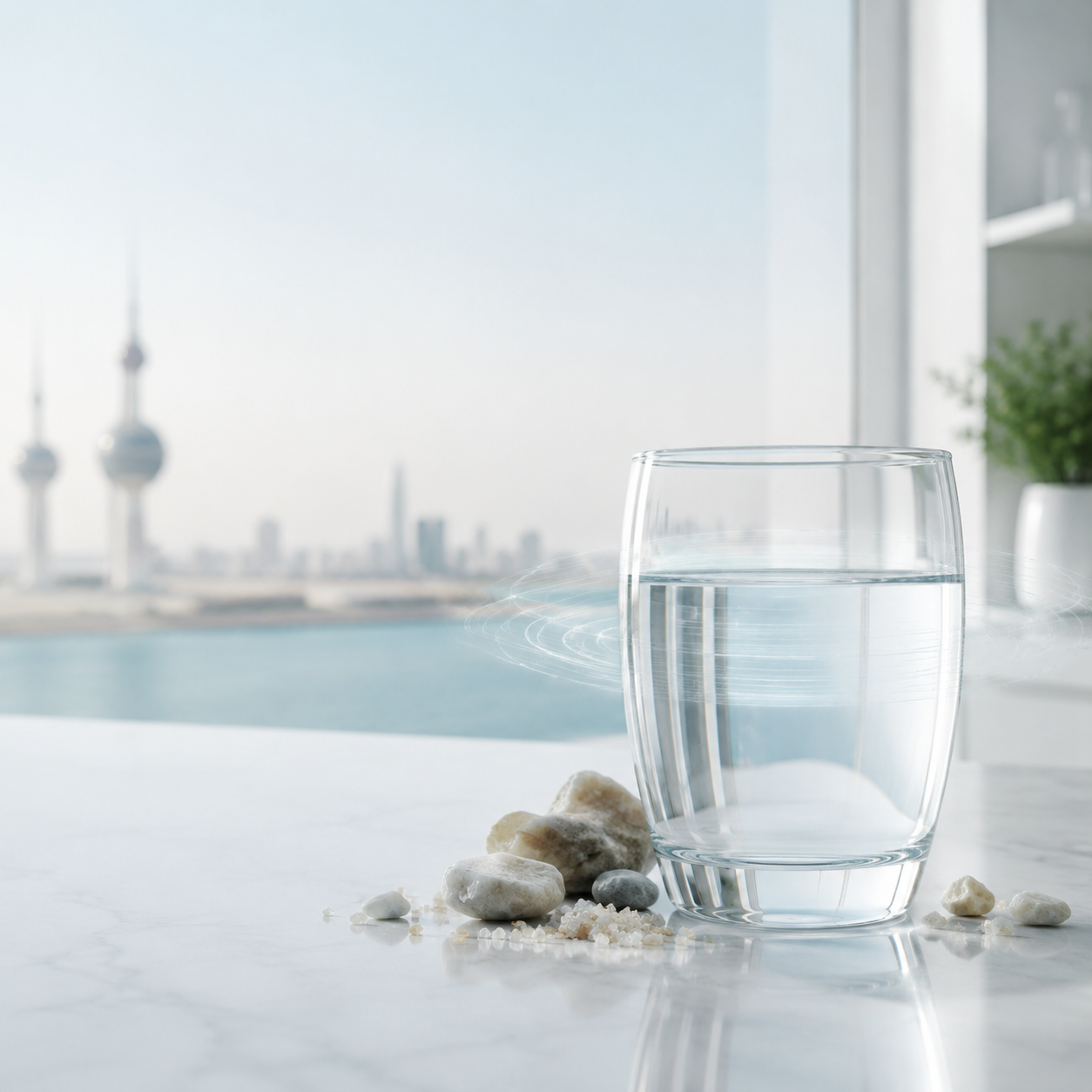
Kuwait has essentially no rivers and minimal renewable freshwater, so the overwhelming majority of its potable supply is produced by desalination — enormous thermal and membrane plants converting Gulf seawater into distilled or near-distilled water. Because pure distillate is too aggressive and flat to distribute on its own, it’s blended with a controlled portion of brackish groundwater and treated to meet potability standards.
It’s a remarkable feat of engineering. It’s also why water in Kuwait tastes different from water in, say, the mountains of Oman or a European spring town — and why “what’s missing” is a more relevant question here than almost anywhere else on Earth.
What does desalination remove — and why does that change taste?
Desalination doesn’t selectively remove salt; it removes almost everything dissolved. What’s lost along with the sodium:
- Calcium and magnesium — the two minerals most responsible for the pleasant “structure” of good water, and contributors to daily dietary intake.
- Bicarbonates — which buffer acidity and give water its rounded, slightly sweet finish.
- Trace minerals — potassium and others present in natural source waters.
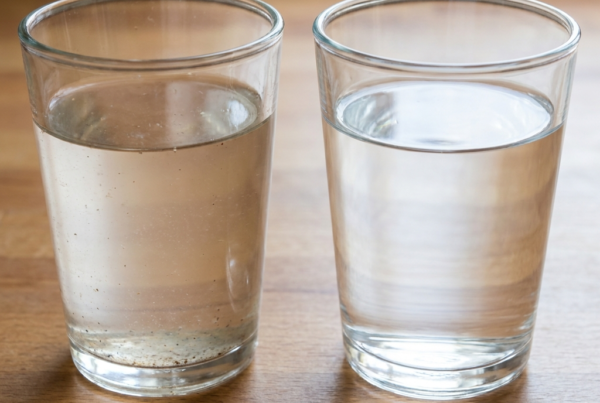
Water without these reads to your palate as flat, thin, or vaguely “empty” — the same reason distilled water is nobody’s favorite drink. Taste panels consistently rate moderately mineralized water (roughly in the 80–300 mg/L TDS range) as the most pleasant, while near-zero TDS water tastes flat and very high TDS water tastes heavy or brackish.
Doesn’t the government add minerals back?
Yes — remineralization and blending are standard steps before distribution. But utility-scale remineralization optimizes for network protection (preventing pipe corrosion) and baseline potability across millions of consumers. It is not, and cannot be, tuned to what tastes best in your glass or what an individual family might prefer for daily hydration.
And whatever balance leaves the plant then travels the last mile — pipes, risers, rooftop tanks — picking up the metallic and sediment notes we’ve covered elsewhere, which mask or distort the intended profile further.
So what’s the ideal setup for a home in Kuwait?
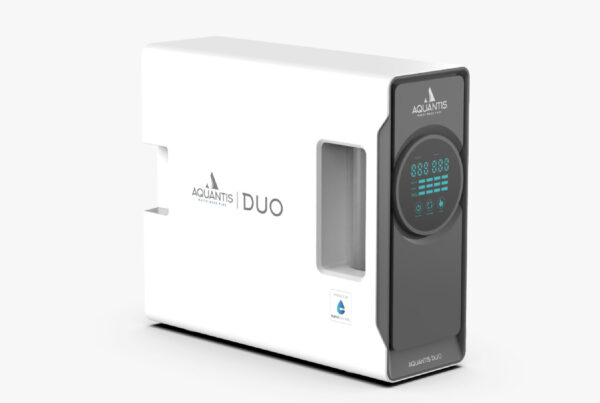
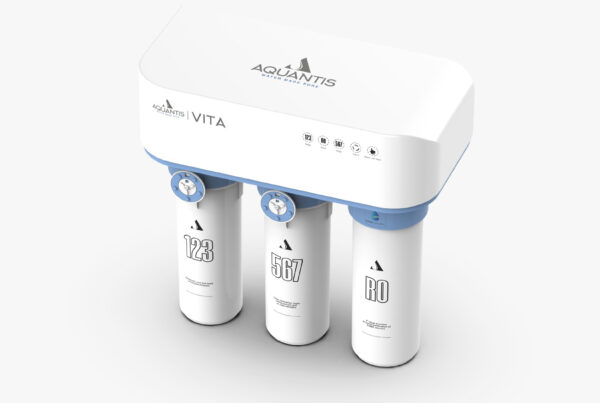
Control the final composition yourself, at the point of use. This is exactly the problem the dual-output architecture in Aquantis was built for:
- First, remove everything — the 8-stage journey, with a DuPont RO membrane at its core, takes water down to near-zero dissolved solids, clearing out last-mile contamination along with residual salts.
- Then, add back precisely what belongs — the mineralized output blends purified water with a precisely measured portion of treated, mineral-carrying water, producing a balanced profile designed for taste and everyday drinking.
- Or don’t — the pure output remains available on demand for uses where near-zero TDS is the right tool: espresso machines, steam irons, aquariums, precision cooking.
One device. Two purities. Your choice — rather than the network’s compromise.
Does mineral content in water actually matter for health?
Minerals in water are bio-available and contribute to daily intake — the WHO has published extensively on calcium and magnesium in drinking water — but food remains the primary source for most people. The honest framing: mineralized water is a meaningful contributor to intake and a major driver of taste and drinking enjoyment, and people demonstrably drink more water when they like how it tastes. For hydration, the best water is the one your family actually reaches for.
FAQ
Why does tap water in Kuwait taste different from bottled water?
Different mineral profiles. Bottled brands each engineer a specific TDS and mineral balance; Kuwait’s network water is a blend optimized for distribution, then altered by the last mile.
Is desalinated water bad for you?
No — properly remineralized desalinated water meets international potability standards. The discussion is about taste and mineral optimization, not safety.
What TDS level tastes best?
Most taste research and drinker preference lands in a moderate range — roughly 80–300 mg/L — which is the territory Aquantis’s mineralized output is designed around.
Can I get both pure and mineralized water from one system?
Yes — that’s the defining feature of Aquantis DUO and VITA: the first dual-output tankless systems in Kuwait.
Taste the difference a controlled mineral profile makes — book a free consultation and water test. → supernaturalco.com