Ask most water purification brands who makes the membrane at the centre of their system and the answer arrives vague. It’s an informative silence. The membrane is the system — everything before it is preparation, everything after it is finishing — and a brand that won’t name its supplier is telling you something.
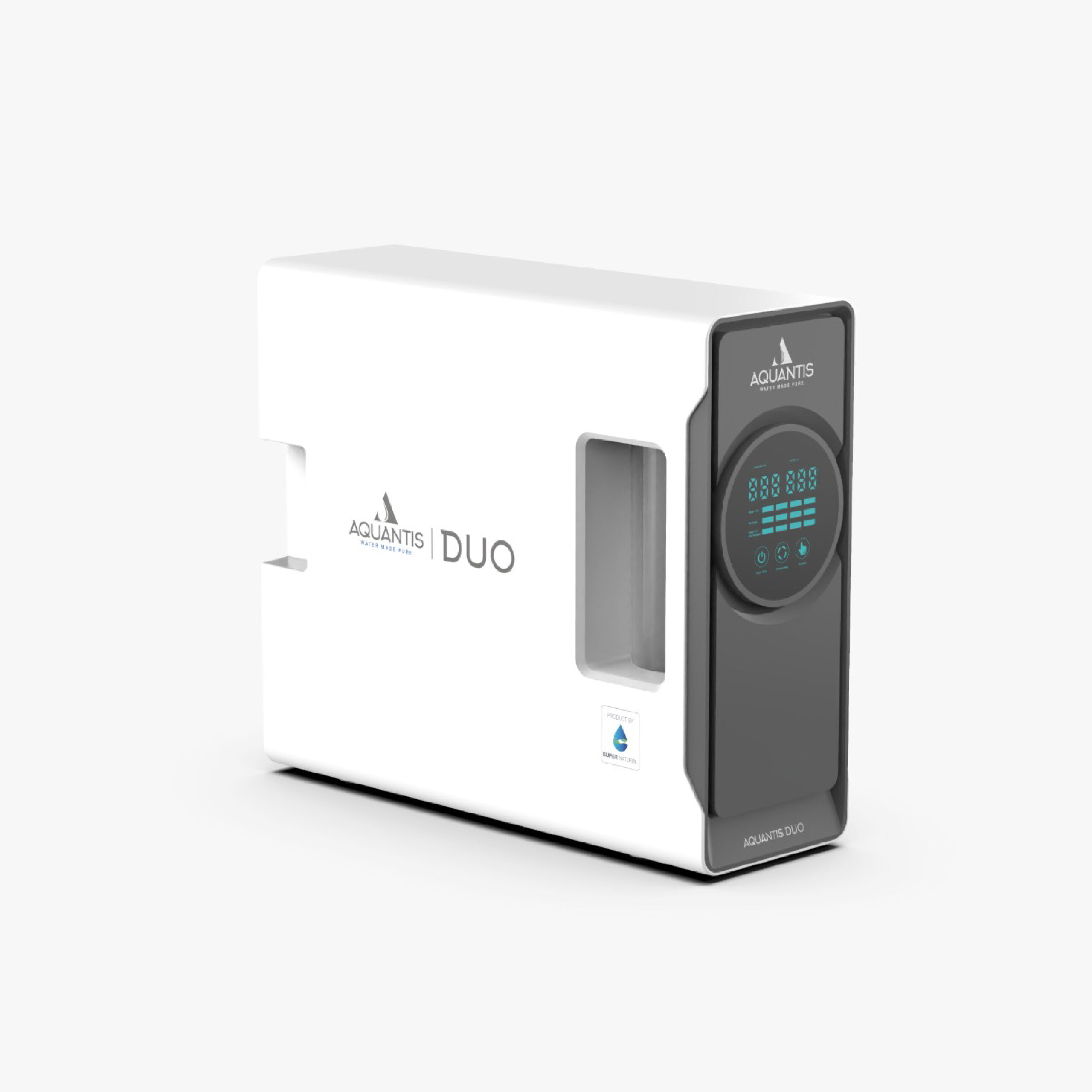
DUO is built around the DuPont TAPTEC reverse osmosis membrane. DuPont is among the originators of RO membrane technology. That’s the sentence this entire product rests on, and it’s why we lead with it.
What the membrane does
Reverse osmosis is the most complete purification available in a domestic system. Pressure drives water across a semi-permeable membrane that rejects dissolved substances themselves — not just particles caught in a sieve, but salts, heavy metals, microplastics and nanoplastics, and the dissolved solids a TDS meter measures.
This matters specifically in Kuwait. Our supply begins as desalinated seawater, is remineralized for distribution, then travels the last mile: kilometres of network pipe, a building’s galvanized risers, a rooftop tank that bakes through summer. Much of what changes your water along that journey arrives dissolved — and dissolved is precisely what ultrafiltration cannot address and RO can.
Two waters, one device
DUO’s defining feature is what happens after purification.
Pure output — water taken to near-zero dissolved solids. This is the right tool for espresso machines, steam equipment, ice makers, and any use where mineral content interferes with the result.
Mineralized output — purified water blended with a precisely measured portion of treated, mineral-carrying water, producing a balanced profile for everyday drinking. Desalinated water arrives at your tap missing much of the calcium, magnesium and bicarbonate that make water taste like water. Mineralized output puts a controlled amount back.
The choice happens at the tap, not at the point of purchase.
One installation note the catalogue is firm about: if the purification port isn’t being used, a rigid plug must seal it. Single-plug mode — sealing one outlet and running the other — is prohibited. This isn’t a preference; it’s a pressure-management requirement, and it’s a reason installation belongs with certified technicians.
Capacity, and being honest about it
DUO is offered across four production configurations:
| Configuration | Production rate |
|---|---|
| 600 GPD | 94 L/h |
| 800 GPD | 126 L/h |
| 1000 GPD | 158 L/h |
| 1200 GPD | 189 L/h |
Rated power scales with it: 96W at 600–800 GPD, 120W at 1000 GPD, 144W at 1200 GPD, on 110–220V/50Hz.
And here is the caveat the catalogue states plainly, which most brands bury: rated capacity is measured at 0.25 MPa inlet pressure and 25°C inlet water temperature. If your building’s actual pressure or water temperature is lower, actual production will be correspondingly lower. Membrane output is a function of the conditions you give it.
This is why we check pressure before recommending a configuration rather than after installing one.
Physical dimensions: 465 × 161 × 410 mm. Operating pressure: 0.1–0.4 MPa. Water temperature: 5–38°C. Source: municipal tap water.
Engineered to be maintained
The catalogue publishes a service interval for every component — an unusual degree of transparency, and a useful signal:
- Electrical control board: 60 months
- Water pump: 60 months
- High-pressure switch, drain and inlet solenoid valves, power adapter: 36 months
- Pressure-bearing parts, manifold assembly, filter housing: 36 months
- Piping components, tee valve, quick-connect fittings, PE tubing, faucet: 36 months
- Filter cartridges: regular maintenance and replacement
Alongside this, the catalogue includes a full fault diagnosis matrix — root cause analysis mapped to corrective protocol for symptoms from “unit fails to start” to “poor purified water taste.” Manufacturers who expect their systems to be discarded don’t write those.
Installation requirements worth knowing
The catalogue is specific, and the specifics are where installations succeed or fail:
PE pipe insertion depth: minimum 15 mm, measured from the pipe end to the bottom of the connector. Under-insertion is the leading cause of slow under-sink leaks.
Hose assembly: use only the components provided. Reusing loose parts or mixing components from different batches is prohibited — rupture from mismatched tolerances is a real failure mode.
No pipeline modification: unauthorised alteration at the product’s joints or pipelines is prohibited.
UV radiation prevention: install in a shaded area. Prolonged UV exposure ages both the housing and the membrane — a live concern in this climate, not a boilerplate warning.
Storage environment: avoid direct sunlight, damp areas, and drainage-prone locations.
Leakage inspection: after installation, inspect the water inlet tee ball valve, external PE pipe and internal connectors for leaks.
Living with DUO
After a water stoppage or pipeline works:
- Turn off the power and close the tee ball valve.
- When supply returns, open other faucets first and flush sediment thoroughly.
- Only then reopen the tee ball valve.
The catalogue’s warning is direct: failure to follow this sequence may severely clog the cartridges. Network maintenance stirs up sediment that has been settling in pipes for years, and drawing it through a fresh membrane is the fastest way to shorten its life.
Cleaning: soft damp cloth only. Soap, detergent, thinner, gasoline and alcohol are prohibited.
Child safety: children must be supervised by adults when operating or approaching the unit.
Power cord: never crush, fold or knot it; a damaged cord must be replaced by a professional.
Servicing: maintenance and cartridge replacement should be performed by certified technicians. Unauthorised disassembly can damage seals and voids the warranty.
The white water question
New owners ask about this more than anything else, so: milky or white water from a new system is almost always dissolved air, not contamination.
Under system pressure, dissolved gases — oxygen, nitrogen — form microbubbles of roughly 10–50 microns that scatter light. Activated carbon adsorption releases a little heat as well, nudging local temperature up by around half a degree to a degree and accelerating gas release.
How to be certain: fill a transparent glass and leave it undisturbed in a dark place for 30 minutes. If it’s bubbles, dissipation rings form at the surface and the cloudiness clears completely. If it’s contaminants, sediment settles at the bottom or particles stay suspended — and that’s a service call, not a wait.
A TDS pen adds confirmation: a normal reading alongside visible suspended particles that clear on standing tells you the membrane is working exactly as intended.
FAQ
Which membrane does the Aquantis DUO use?
The DuPont TAPTEC reverse osmosis membrane. DuPont is among the originators of RO membrane technology.
How much water does DUO produce?
94 to 189 litres per hour depending on configuration (600–1200 GPD). Rated capacity assumes 0.25 MPa inlet pressure and 25°C water temperature; lower pressure or temperature reduces output proportionally.
Can DUO give both pure and mineralized water?
Yes — both outputs from one device, selected at the tap. Pure output for near-zero-TDS applications, mineralized for everyday drinking.
What are DUO’s dimensions?
465 × 161 × 410 mm.
Does reverse osmosis remove microplastics?
Yes. An RO membrane rejects particles far smaller than microplastics, including nanoplastics.
How long do DUO’s components last?
The control board and water pump are rated at 60 months; most valves, fittings and pressure-bearing components at 36 months. Cartridges follow their own replacement schedule.
Book a free in-home water test — we’ll measure your pressure and TDS and recommend the right configuration rather than the largest one. → supernaturalco.com