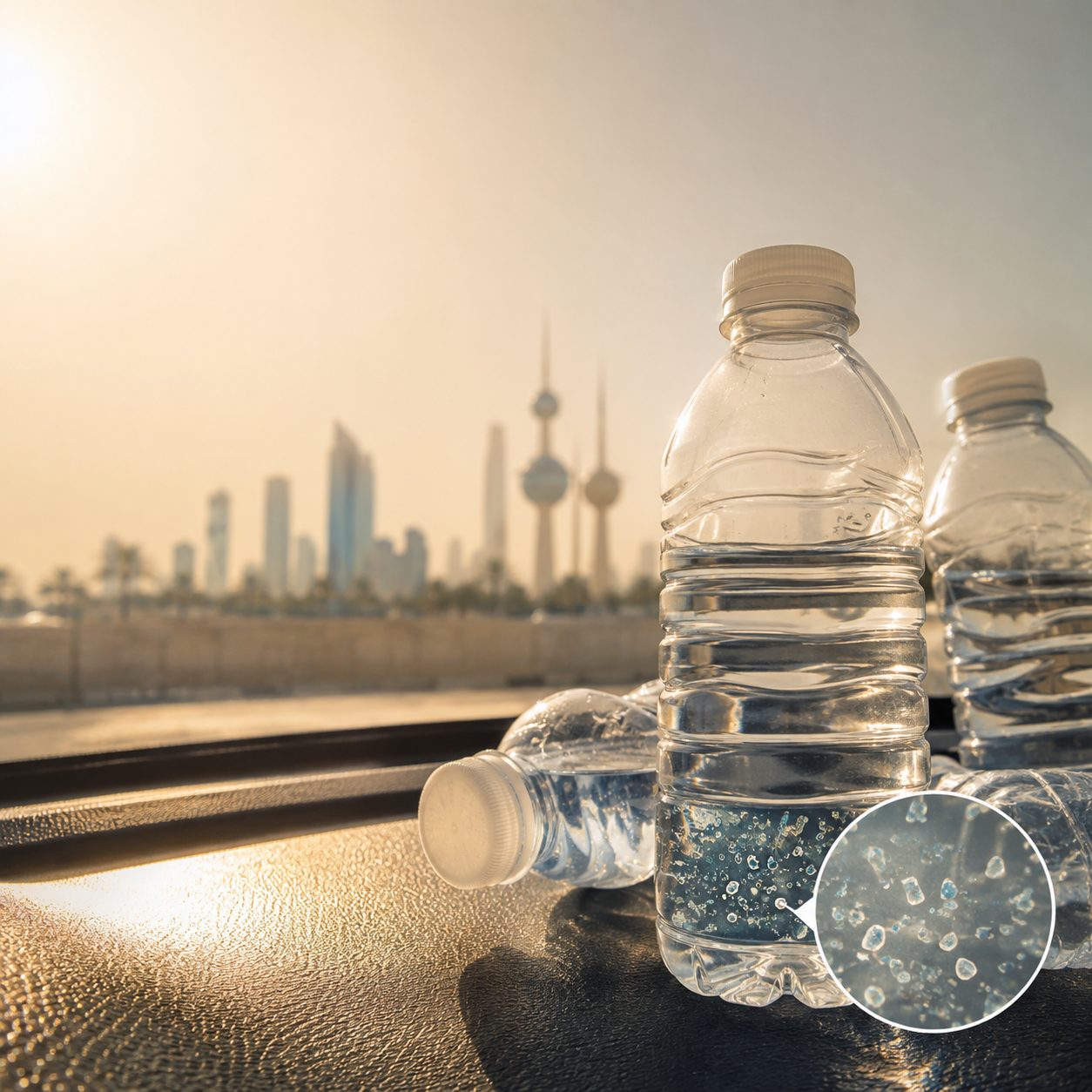
The short answer: Research shows bottled water already contains plastic particles — a 2024 peer-reviewed study using new laser-imaging techniques counted an average of roughly 240,000 plastic fragments per liter, most of them nanoplastics. Separate studies show heat accelerates the migration of plastic-associated compounds from bottle to water. A car parked in Kuwait’s summer, where cabin temperatures can far exceed 60°C, is close to a worst-case storage environment.
What did the research actually find?
For years, microplastics research was limited by what microscopes could see. In 2024, researchers at Columbia University published a study in PNAS using a new imaging method capable of detecting nanoplastics — particles small enough to pass through biological barriers. Bottled water samples averaged around 240,000 plastic particles per liter, roughly 90% of them nanoplastics, an order of magnitude beyond earlier estimates that counted only larger microplastics.
To be scientifically honest: the long-term health effects of ingested nanoplastics are still being studied, and no regulator has set a safe or unsafe threshold. What is established is the exposure itself — the particles are there, and bottled water is one of the most direct routes.
Does heat make it worse?
Yes — this part is well documented. Multiple studies have found that elevated temperatures increase the migration of compounds from PET and polycarbonate bottles into water, including antimony (a catalyst used in PET production) and, in some plastics, bisphenol compounds. The mechanisms are straightforward chemistry: heat increases molecular mobility, and repeated heating-cooling cycles stress the polymer structure.
Now consider the typical lifecycle of a water bottle in Kuwait between June and September:
- Transported in unrefrigerated trucks through 45–50°C afternoons
- Stored on pallets, sometimes outdoors, at distribution points
- Left in car trunks and cabins where temperatures can exceed 60–70°C
- Cooled, warmed, and cooled again — the exact cycling that stresses plastic
The bottle you drink from in August has often lived through weeks of thermal stress you never saw.
Is this a reason to panic about bottled water?
No — and we won’t pretend otherwise. Bottled water remains regulated and broadly safe by current standards. But two things can be true at once: bottled water is not dangerous, and it is not the pristine product its marketing suggests — particularly in a climate that works against plastic packaging for four months a year.
Add the practical costs — the recurring monthly spend, the storage, the plastic waste — and the case for bottled water in Kuwait becomes harder to defend on any dimension: purity, economics, or sustainability.
What’s the alternative for a Kuwaiti household?
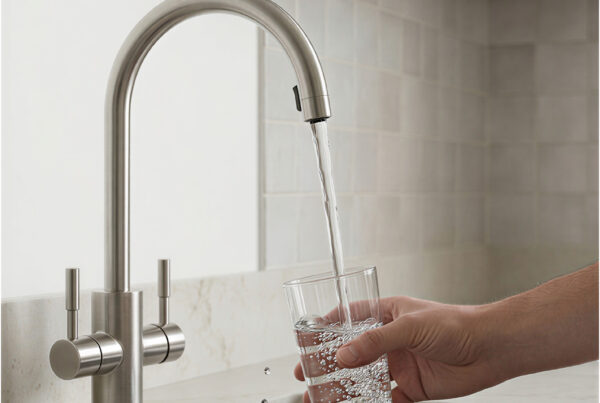
Purify at the tap, refill in glass or steel. A multi-stage reverse osmosis system removes up to 99% of dissolved solids — and the RO membrane’s pore size means microplastics and nanoplastics are among the contaminants it’s physically built to reject. With a dual-output system like Aquantis DUO or VITA, you choose pure or mineralized water on demand, with no plastic in the chain and no thermal history to wonder about.
Your water is purified seconds before you drink it, in your kitchen — not months before, in a truck.
Practical summer rules (whatever water you drink)
- Never store bottled water in the car — treat the cabin like the oven it is.
- Buy from retailers who store stock indoors and cooled.
- Don’t refill single-use PET bottles; they’re engineered for one use.
- Prefer glass or stainless steel for daily carry.
- If a bottle has been heat-exposed, use it for anything but drinking.
FAQ
Is it safe to drink water from a bottle left in a hot car?
One bottle, once, is very unlikely to cause harm. The concern is cumulative exposure from routinely drinking heat-stressed bottled water — a routine Kuwait’s climate makes common.
Do microplastics exist in tap water too?
Yes, generally at lower concentrations than bottled water in most studies. A point-of-use RO system addresses both sources at once.
Does freezing bottled water release chemicals?
Freezing slows chemical migration rather than accelerating it; the persistent myth confuses freezing with heating. Heat is the documented risk factor.
Does reverse osmosis remove microplastics?
Yes — RO membranes reject particles far smaller than microplastics, and the Aquantis 8-stage journey adds carbon and UV stages beyond the membrane itself.
Skip the plastic and its thermal history — see which Aquantis fits your home. → supernaturalco.com