Why do specialty cafés obsess over water?
Because water isn’t the medium of coffee — it’s the main ingredient and the solvent doing the extraction. Its mineral content determines how efficiently flavor compounds dissolve:
- Too few minerals (near-zero TDS) and extraction turns aggressive — sour, sharp, hollow cups, and water corrosive to boiler components.
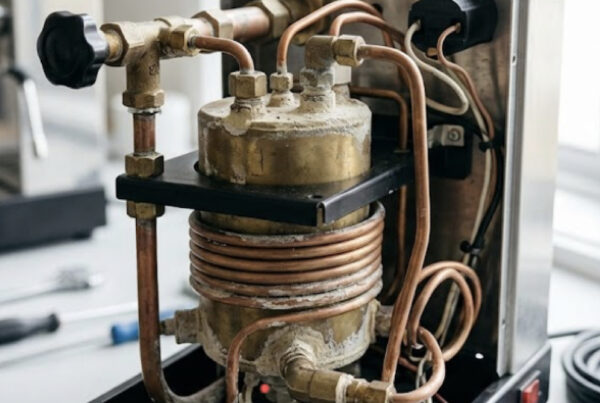
- Too many minerals (high TDS, high hardness) and extraction dulls — flat, muddy cups — while scale steadily coats your heat exchangers.
- Chlorine at any level taints aromatics directly. It’s the fastest way to make expensive beans taste cheap.
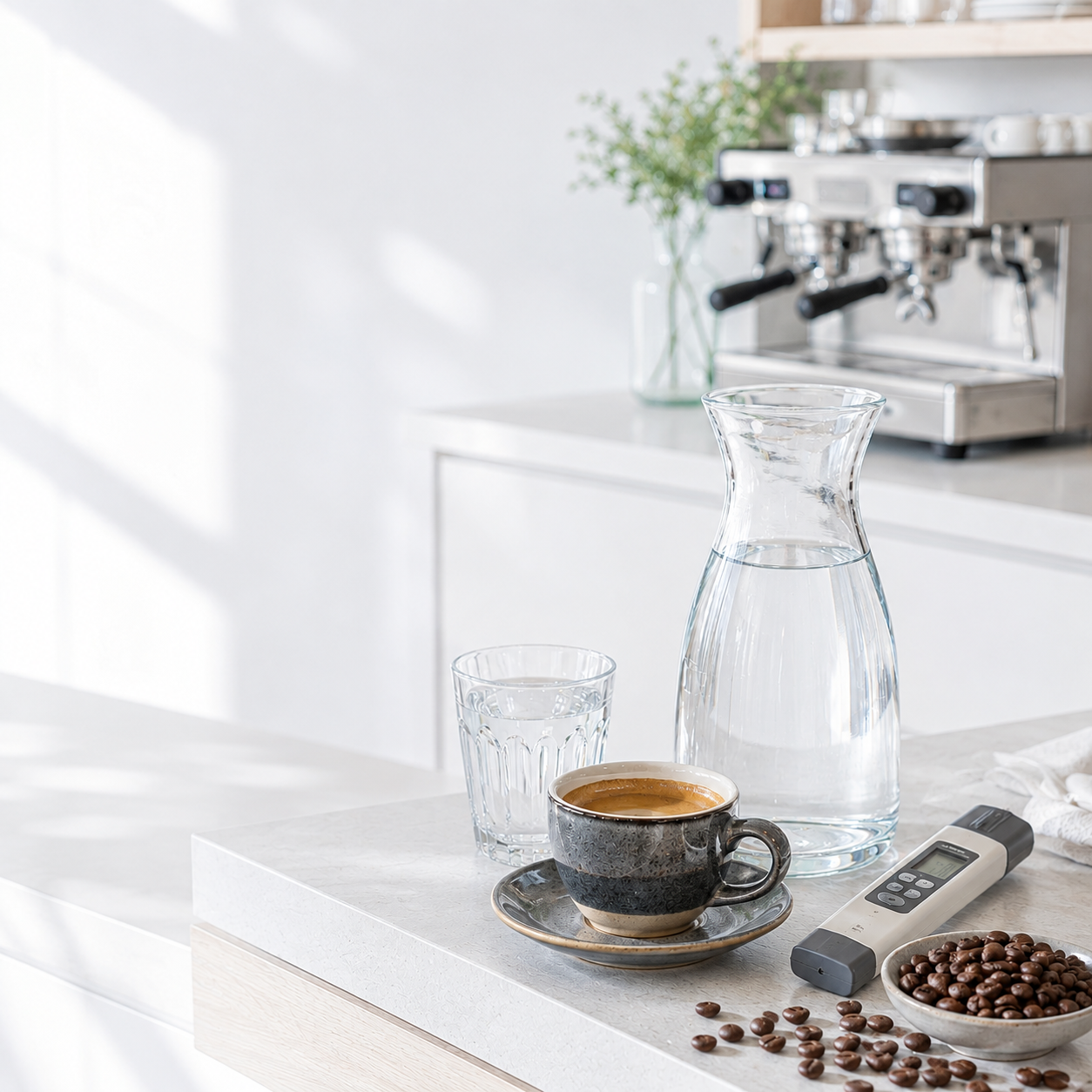
The SCA’s published water quality standard exists precisely because identical beans, machine, and barista produce measurably different cups on different water. Target values: around 150 mg/L TDS, calcium hardness in a moderate band, alkalinity near 40 ppm, pH near 7, and no chlorine or odor.
What does Kuwait’s water look like against that standard?
Unpredictable — which for a café is the worst word in quality control. Desalinated, remineralized network water leaves the plant at one profile, then picks up variability through distribution lines, building risers, and storage tanks: chlorine residuals, sediment, metallic notes, and hardness that shifts by district and by building. Two branches of the same café in different areas can pull noticeably different shots with identical recipes.
And there’s the equipment side, which we’ve covered in The Silent Killer of Coffee Machines: scale buildup on heating elements is the leading cause of espresso machine breakdowns, degraded temperature stability, and shortened equipment life.
What about ice?
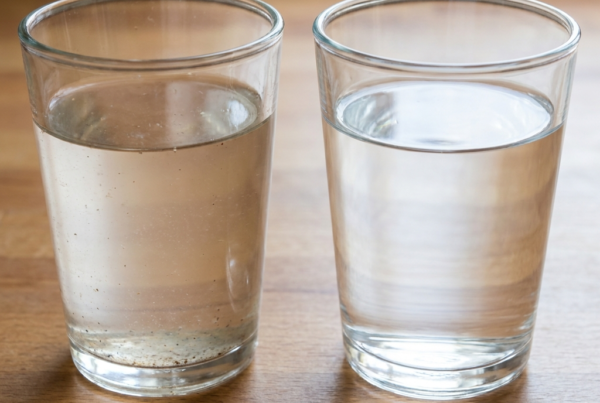
Ice is the most visible water quality verdict in your business. Cloudy, white-cored ice is caused by dissolved solids and trapped air freezing outward; off-tasting ice transfers directly into every beverage it touches. Clear, neutral ice requires low-TDS, chlorine-free feed water — full stop. For a specialty café or boutique hotel bar, cloudy ice quietly undermines everything else you charge a premium for.
How do cafés get water right?
The professional approach is a dedicated purification line feeding espresso machines, brewers, and ice makers:
- Sediment and carbon pre-treatment — removes particles and eliminates chlorine before it reaches the machine or the cup.
- Reverse osmosis — takes the water to a clean, near-zero baseline, erasing the building’s last-mile variability entirely.
- Controlled remineralization — blends minerals back to a stable, repeatable target profile in the SCA’s preferred range.
This is the exact architecture of the Aquantis dual-output system. The pure output feeds ice makers and steam equipment; the mineralized output delivers a consistent extraction profile for espresso and brewing — both from one installation. Aquantis DUO runs a DuPont TAPTEC RO membrane and is offered up to 1200 GPD — 189 litres per hour — capacity engineered for commercial service, not just household use.
The result is the one thing chain-level quality depends on: the same water, every day, in every drink, at every branch.
What’s the business case?
- Consistency — recipes dialed in once stay dialed in; no more re-calibrating shots because the water changed.
- Equipment protection — dramatically reduced scale means fewer service calls, longer machine life, and stable brew temperatures.
- Product quality — clear ice, clean aromatics, and better-tasting water service (which customers notice more than owners expect).
- Cost control — replacing bottled/delivered water for brewing and service eliminates a permanent recurring line item.
FAQ
What TDS is best for espresso?
The SCA targets roughly 150 mg/L, with 75–250 mg/L acceptable. Stability matters as much as the number — a fixed profile beats a “better” but fluctuating one.
Can I run an espresso machine on pure RO water?
Not recommended — very low-mineral water extracts poorly and can be aggressive toward boiler metals. Remineralized RO water is the professional standard.
Why is my café’s ice cloudy?
Dissolved solids and gases in the feed water. Low-TDS purified feed water is the fix.
Can one system serve espresso machines, brewers, and ice makers together?
Yes — a dual-output system supplies near-zero-TDS water for ice and steam and mineralized water for extraction from a single installation. Commercial capacity sizing (DUO reaches 189 litres per hour at 1200 GPD) is the key spec to check.
Get a free on-site water assessment for your café or restaurant — including a TDS and hardness reading against SCA targets. → supernaturalco.com