Most water purification systems are specified as if every home were a villa. Then the installer opens the cabinet under a Salmiya apartment sink, finds a waste trap, a stopcock and about forty centimetres of usable depth, and the conversation becomes an apology.
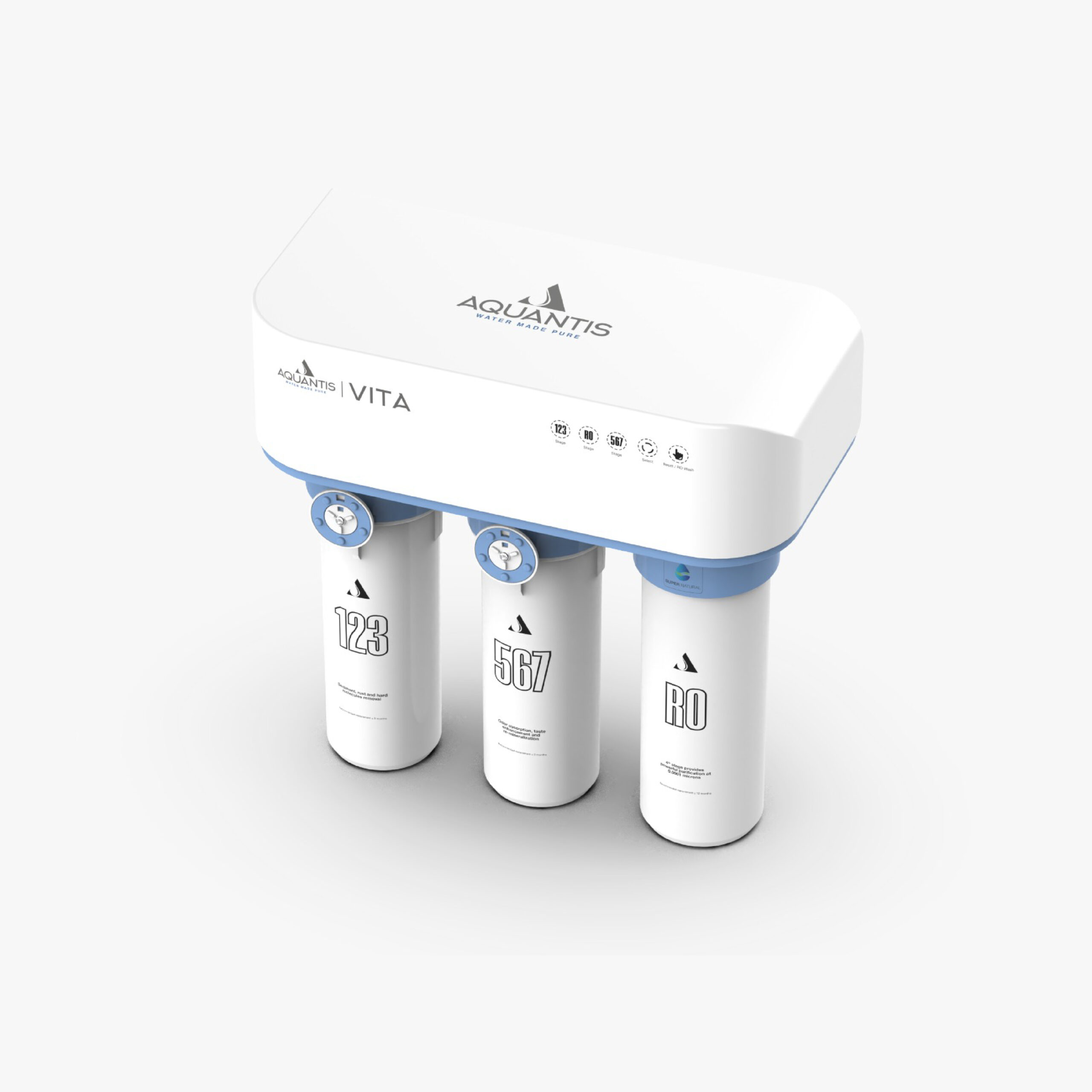
VITA was designed around that cabinet rather than around the brochure.
The dimension that decides everything
VITA measures 395 × 185 × 395 mm. The number that matters most in practice is the 185 mm depth — the dimension that determines whether a system slides in behind existing plumbing or fights it.
This is not a compromise on capability. VITA is a full reverse osmosis system offered across the same production range as much larger units: 600, 800, 1000 or 1200 GPD depending on configuration, which translates to 94, 126, 158 or 189 litres per hour. A compact body, not a compact specification.
What reverse osmosis is doing inside it
Ultrafiltration works by physical sieving — a pore small enough to stop particles. Reverse osmosis works differently and more thoroughly: pressure drives water across a semi-permeable membrane that rejects dissolved substances themselves. Salts, heavy metals, microplastics and nanoplastics, and the dissolved solids that a TDS meter counts.
This is why RO is the answer when the problem is dissolved rather than suspended — and in Kuwait, where the supply begins as desalinated seawater and then travels the last mile through distribution lines, building risers and rooftop tanks, a good deal of what changes your water is dissolved.
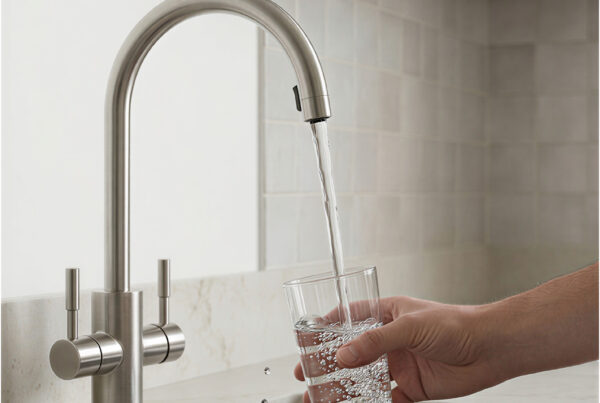
VITA delivers dual output: near-zero-TDS pure water for the uses that demand it, and mineralized water blended for balanced everyday drinking. You are not choosing between purity and taste at purchase — you choose at the tap, each time.
What VITA needs from your home
- Water source: municipal tap water
- Temperature range: 5–38°C
- Operating pressure: 0.1–0.4 MPa (1–4 bar / 14.5–58 psi)
- Power: 110–220V / 50Hz
A note the catalogue makes explicitly, and worth restating: rated production capacity is measured under standard conditions of 0.25 MPa inlet pressure and 25°C inlet temperature. If your building’s actual pressure or water temperature runs lower, production runs proportionally lower too. It’s an honest caveat, and the reason a pre-installation pressure check is part of our process rather than an afterthought.
Built to be serviced, not replaced
The catalogue publishes maintenance intervals for every component, which tells you something about the design intent:
- Electrical control board: 60 months
- Water pump: 60 months
- High-pressure switch, solenoid valves, power adapter: 36 months
- Pressure-bearing parts, piping components, fittings, PE tubing, faucet: 36 months
- Filter cartridges: regular maintenance and replacement
Systems designed as disposable don’t publish a five-year rating on their pump. These figures describe equipment meant to be kept.
Installation matters more than people expect
Three specifications from the catalogue that separate a good installation from a leak eighteen months later:
PE pipe insertion depth. Pipes must be inserted to a minimum of 15 mm, measured from the pipe end to the bottom of the connector. Under-insertion is the single most common cause of slow leaks in under-sink systems.
No unauthorised pipeline modification. Cutting, splicing or mixing components from different batches is prohibited — mismatched tolerances are how pressure ruptures start.
UV radiation prevention. The device must be installed in a shaded area. Prolonged UV exposure ages the housing and the RO membrane. This is not a theoretical concern in Kuwait.
The catalogue is unambiguous that installation should be performed by certified technicians. So are we — but for a reason worth stating plainly: an RO system is a pressurised device inside a cabinet full of your belongings.
Living with VITA
After a water stoppage or pipeline maintenance:
- Turn off the power and close the tee ball valve.
- Once supply is restored, open your other faucets first and flush sediment thoroughly.
- Only then reopen the tee ball valve.
Following that sequence protects the cartridges. Skipping it, the catalogue warns bluntly, may severely clog them.
Cleaning: wipe with a soft damp cloth only. Soap, detergent, thinner, gasoline and alcohol are all prohibited — they degrade the housing.
Child safety: children should be supervised by adults when operating or approaching the unit.
Power cord: don’t crush, fold or knot it. If damaged, it must be replaced by a professional.
Extended absence: turn off the power and close the tee ball valve before travelling.
If your water looks milky at first
This is the most common question new owners ask, and the answer is reassuring: white or cloudy water from a new RO system is nearly always dissolved air.
Under system pressure, dissolved gases such as oxygen and nitrogen form microbubbles of roughly 10–50 microns. They scatter light, which the eye reads as cloudiness. Activated carbon adsorption releases a small amount of heat as well, raising local temperature slightly and accelerating gas release.
The test: fill a transparent glass, leave it in a dark place for 30 minutes. Bubbles dissipate from the surface and the water clears completely. Genuine contaminants settle at the bottom or remain suspended — and that’s when you call us.
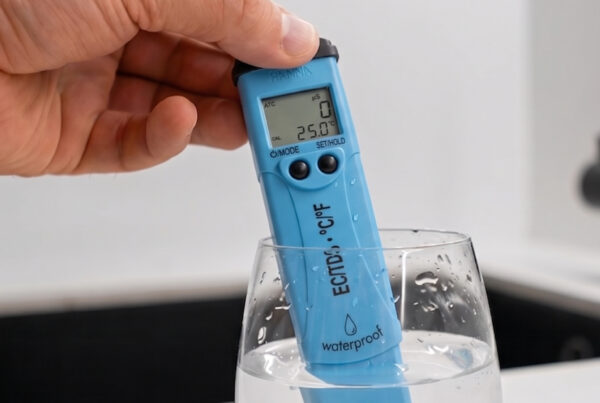
You can also verify the system directly with a TDS pen: a normal reading with suspended particles visible, and clarity returning after standing, together confirm the system is doing its job.
FAQ
How much water does the Aquantis VITA produce?
Between 94 and 189 litres per hour depending on configuration — 600, 800, 1000 or 1200 GPD. Rated capacity assumes 0.25 MPa inlet pressure and 25°C water; lower pressure or temperature reduces output proportionally.
Will VITA fit under a standard apartment sink?
Its 185 mm depth is designed for exactly that constraint. We measure your cabinet during the free consultation rather than assume.
Does VITA give pure or mineralized water?
Both — you choose at the tap. Pure output for near-zero TDS uses; mineralized output for balanced everyday drinking.
Does VITA need electricity?
Yes, 110–220V / 50Hz.
Where should VITA be installed?
In a shaded area, away from direct sunlight, damp locations and drainage-prone spots, with PE pipes inserted at least 15 mm into each connector. Installation should be performed by certified technicians.
We’ll measure your cabinet, check your pressure and test your water — free, in your home. → supernaturalco.com